The short answer
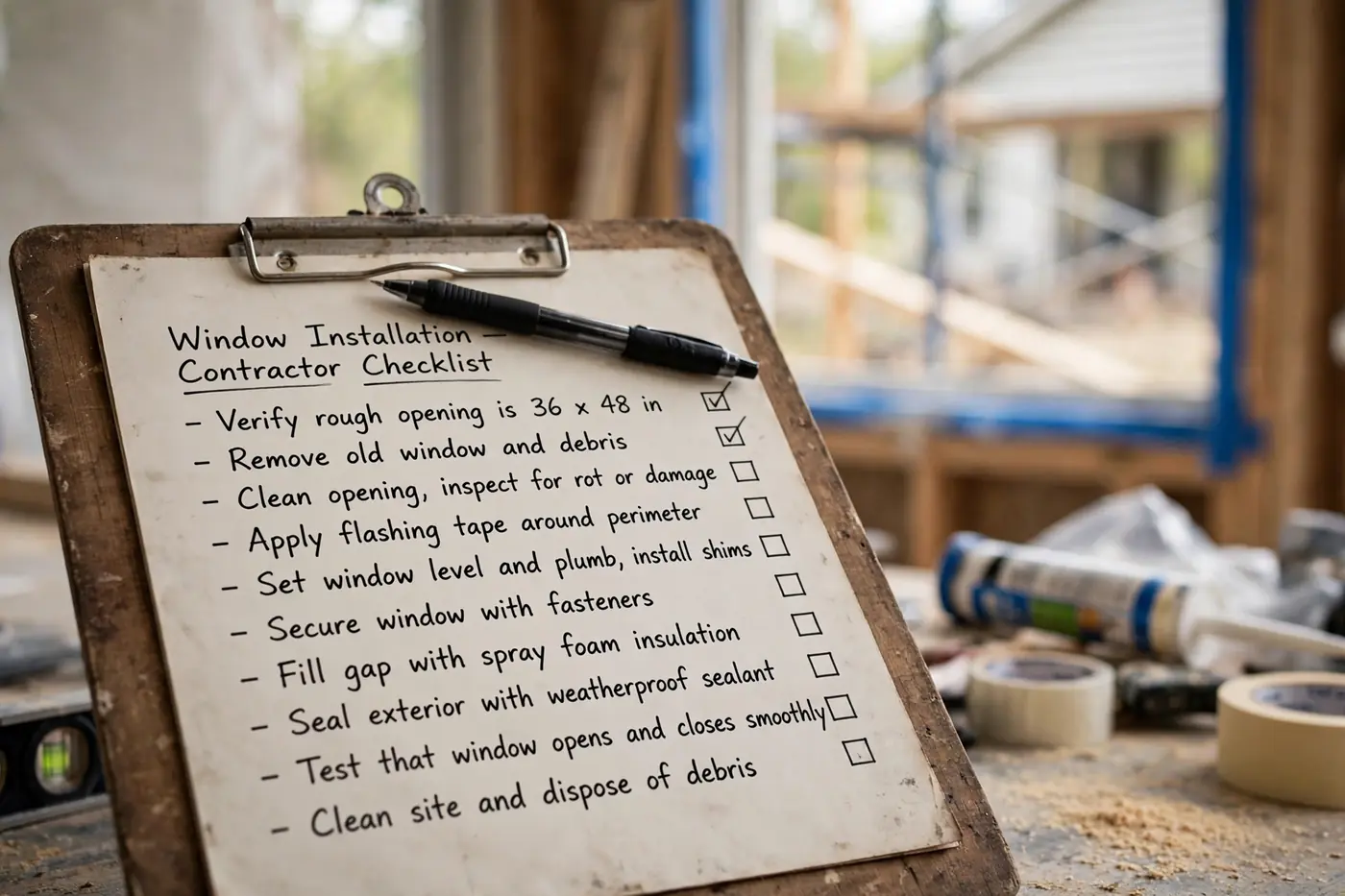
Before signing a window contract, ask about licensing and insurance, the exact product and glass ratings, installation method, who does the work, warranties, payment schedule, hidden-damage pricing, trim and finish scope, timeline, cleanup, warranty transferability, and the callback process. A trustworthy contractor answers all twelve directly and in writing; evasive or annoyed answers tell you to keep shopping.
How to use this list
Print it or keep it on your phone during every contractor visit. You’re not trying to interrogate anyone — you’re doing what professionals do in every trade: qualifying the vendor before committing thousands of dollars. Good contractors like informed customers; it means fewer misunderstandings later. If a salesperson gets defensive at question three, you’ve learned something valuable for free.
Ask for the important answers in writing — on the quote or in an email. Verbal promises about warranties, timelines, and scope have a way of evaporating. What follows pairs each question with why it matters and what a good answer sounds like, so you can judge responses on the spot.
The 12 questions
1. Are you licensed and insured? Can I see the certificates?
Why it matters: This is the non-negotiable foundation. An unlicensed contractor leaves you with little legal recourse if things go wrong, and uninsured workers on your property are a liability nightmare. More practically, any company that can’t produce these basics is cutting corners elsewhere too.
A good answer sounds like: “Here’s our license number — you can verify it on the state board site — and I’ll email you our general liability and workers’ comp certificates today.” No hesitation, no excuses about paperwork being “at the office.”
2. What exact brand, model line, and glass package are you quoting — with ratings?
Why it matters: “Premium vinyl windows” is not a product description; it’s a vibe. Without the exact model and its U-factor and SHGC ratings, you can’t compare bids, verify ENERGY STAR certification, or confirm the crew installs what you bought. This is also your main defense against bait-and-switch.
A good answer sounds like: A specific brand and series, the glass package (double-pane, low-E, argon), and the NFRC ratings — “U-0.27, SHGC 0.25, ENERGY STAR certified for our zone.” Learning to read those three numbers takes about five minutes and pays off on every quote you compare.
3. Is this insert or full-frame installation — and why is that the right method for my house?
Why it matters: The installation method is one of the biggest cost and quality variables in the project — full-frame can add 40 to 100 percent over insert pricing. But it’s not just about cost: the wrong method causes real problems. Insert installation over rotted frames is money wasted; full-frame where inserts would do is money overspent.
A good answer sounds like: A clear recommendation tied to what they observed: “Your frames are solid, so insert replacement works on 9 of 10 windows — but the two south-facing sills show rot, so those need full-frame.” Method matched to evidence, not to margin.
4. Who will actually do the installation — your employees or subcontractors?
Why it matters: The window’s rated performance assumes competent installation, and the crew determines that more than the brand does. Neither arrangement is automatically bad — many excellent installers are long-term subs — but you deserve to know who’s coming, how long they’ve done this work, and who supervises them.
A good answer sounds like: “Our own three crews — the lead on your job has been with us six years,” or “We use the same two subcontracting crews for all our work; here’s how long we’ve worked together.” Vague answers (“we have guys”) are the ones to worry about.
5. What is your workmanship warranty, separate from the manufacturer’s?
Why it matters: Manufacturer warranties cover the product; they don’t cover a window installed out of square or flashing done wrong. Installation defects are the most common source of callbacks, and they’re the installer’s responsibility — but only if the warranty says so, in writing, with a duration.
A good answer sounds like: “Five years on installation workmanship, in writing, covering air and water infiltration from installation defects.” One year is the bare minimum; five is the mark of a company that stands behind its crews. Run from anyone who folds workmanship into “the manufacturer’s lifetime warranty” — those are different things.
6. What is the payment schedule?
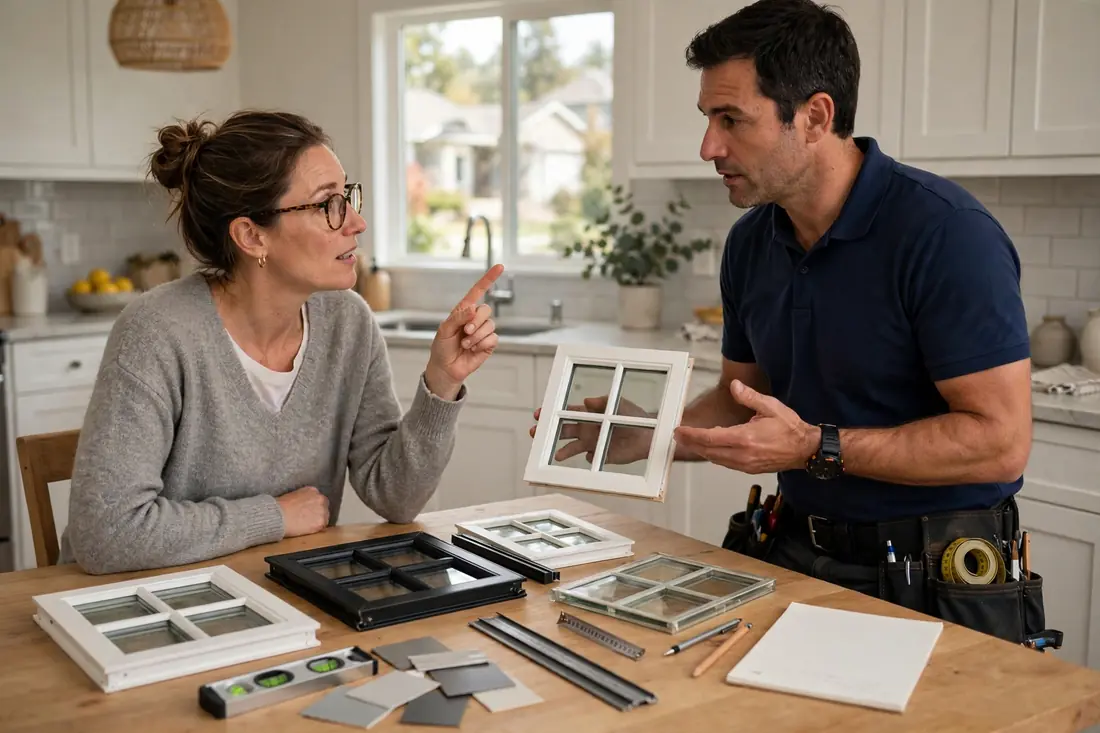
Why it matters: Payment structure is leverage structure. Once a contractor holds most of your money, your ability to demand fixes evaporates. The industry’s standard rhythm — modest deposit, payment on material delivery, balance on satisfactory completion — exists to protect both sides.
A good answer sounds like: “Twenty percent at signing, forty when materials arrive, forty on completion after your walkthrough.” Be cautious of deposits above 25 percent or anyone wanting full payment before the work starts. This is also one of the clearest window replacement red flags — legitimate companies don’t need your cash to fund your job.
7. What happens — and what does it cost — if you find rotted framing or hidden damage?
Why it matters: Old houses hide surprises, and discovering rot mid-installation is genuinely common. The question isn’t whether it might happen; it’s whether the pricing is pre-agreed or invented at maximum leverage with your walls open.
A good answer sounds like: A per-opening price in the contract before work begins: “Rotted sill replacement runs $X per opening; we stop, show you photos, and get approval before proceeding.” Pre-agreed pricing plus photographic proof is the honest system. “We’ll figure it out if we find anything” is not.
8. Exactly what trim and finish work is included?
Why it matters: This is where quotes most often diverge invisibly. Interior trim, exterior aluminum capping (wrapping the old wood trim), caulking, insulation type around the frame, and paint touch-up can represent 10 to 20 percent of project value. Two bids $2,000 apart are often just answering this question differently.
A good answer sounds like: An itemized list: “New interior colonial casing, exterior aluminum capping in matching color, low-expansion foam insulation, full caulk and seal, haul-away of old units.” Ask specifically about the insulation — low-expansion spray foam outperforms fiberglass batt around the frame, and it’s worth confirming which you’re getting.
9. What is the realistic timeline, from measurement to finished installation?
Why it matters: Custom windows are manufactured to order — typically a 4- to 8-week lead time — and contractors juggle multiple jobs. An unrealistic timeline (“we’ll be done next week”) signals either a stock-window bait or a schedule about to slip. You need the truth to plan around open wall cavities and crew access.
A good answer sounds like: A phased estimate with the manufacturing lead time stated honestly: “Measure this week, 5 to 6 weeks for manufacturing, then two days for installation of your 12 windows.” Our window replacement timeline guide breaks down what each phase involves so you can sanity-check what you hear.
10. How do you handle cleanup and disposal?
Why it matters: Window replacement generates real debris — old sashes, glass, trim offcuts, and a shocking amount of dust. “We’ll clean up” means nothing; the details mean everything, especially with kids or pets in the house.
A good answer sounds like: “We tarp floors and furniture in work areas, vacuum with HEPA filters daily, haul all old windows and debris, and do a final walkthrough with you including a magnet sweep for nails outside.” If anyone in the home is sensitive to dust, ask about their dust-control setup specifically.

11. Is the manufacturer warranty transferable if I sell the house?
Why it matters: Transferable warranties are a genuine resale asset — buyers’ agents notice them. Non-transferable warranties die with your ownership. This question also reveals whether the contractor actually understands the product they’re selling or is just repeating “lifetime warranty” as a slogan.
A good answer sounds like: A specific answer about that manufacturer’s policy: “Yes — the 20-year glass seal warranty transfers once to the next owner; here’s the transfer form.” Vague assurances without the actual terms aren’t an answer.
12. If something goes wrong after installation, what is your callback process?
Why it matters: Even good installations occasionally need adjustment — a sash that sticks, a lock that needs alignment, a draft that appears in the first cold snap. What separates professionals from the rest isn’t perfection; it’s what happens next.
A good answer sounds like: “Call or text this number — it reaches our service coordinator, not a call center. We schedule warranty visits within two weeks, and adjustments in the first year are free.” Ask how they handled their last callback. The comfort with which they answer tells you how often they do it well.
How to score the answers
You don’t need a spreadsheet, but a simple mental scorecard works wonders. After each visit, note:
- Green: direct answer, in writing or offered in writing without being asked
- Yellow: answered verbally but vaguely, or “I’ll get back to you” (fine once — follow up)
- Red: deflected, annoyed, or contradicted the written quote
Two or more reds and that bidder is out, regardless of price. A pattern of yellows means the quote needs everything nailed down in writing before you’d consider it. The winner is usually obvious: the contractor with the most greens at a competitive price. Price breaks ties between qualified bidders — it should never override qualification.
Quick answers
Should I ask all 12 questions at the first visit?
Yes — that’s what the visit is for. A real consultation runs 60 to 90 minutes; there’s plenty of time. If a salesperson seems rushed by thorough questions, they’re telling you their business model depends on quick closes, which is information too.
What if a contractor refuses to put something in writing?
Treat the refusal as the answer. Anything a contractor won’t write down is something they don’t intend to guarantee. This applies especially to warranty durations, the exact product spec, and the payment schedule.
Can I use these questions to negotiate?
Absolutely — they’re more effective than haggling. “Your competitor includes five-year workmanship warranty and foam insulation at the same price” is a factual, respectful negotiation grounded in scope, not theatrics. Our quoting tutorial shows how to use competing bids as leverage.
Do these questions apply to big national companies too?
Especially to them. National brands often use commissioned salespeople and subcontracted crews, which makes questions 4, 5, and 12 even more important. Brand reputation doesn’t install windows — the local crew does.
What if I’ve already signed and didn’t ask these?
Review your contract against this list right now. Missing items — especially the exact product spec, payment schedule, and warranty terms — can often be clarified in a written addendum before work starts. If the contractor won’t amend, check your cancellation terms; many states give you a three-day right to cancel home solicitation contracts.
Your next step
Save this list where you’ll have it during appointments — and use it on every bidder, even the one your neighbor recommended. Glowing referrals are a great starting point, but your house, your scope, and your contract deserve their own verification. Pair these questions with 3+ itemized quotes for an identical defined scope, verify license and insurance independently, and you’ll sign with the rarest thing in this industry: genuine confidence. The best window project isn’t the cheapest one — it’s the one where you knew exactly what you were buying before the first old sash came out.