The short answer
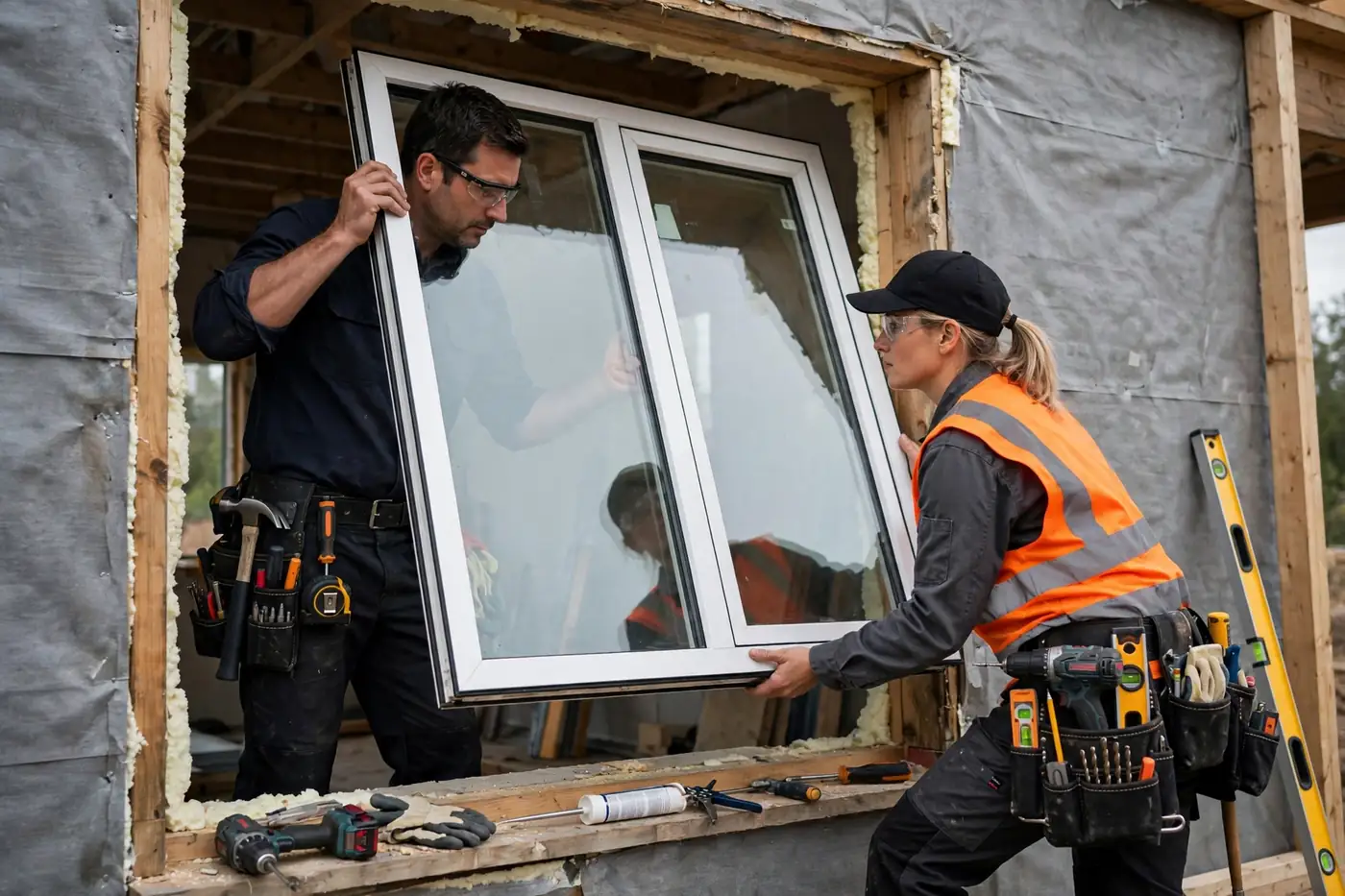
Window installation labor typically costs $100–$300 per window, or roughly 20–40% of your total project cost. That covers removal of the old unit, preparing the opening, setting and leveling the new window, insulating and sealing, interior/exterior trim work, and cleanup. Based on national cost guides as of 2026, complex jobs — second stories, full-frame replacements, rot repair — push labor higher. Always get 3+ itemized local quotes.
What “labor” actually covers
Most homeowners picture labor as “the guy puts the window in the hole.” The actual job is closer to a dozen small tasks, and understanding them explains why two quotes for the “same” window can differ by hundreds of dollars.
A standard professional installation typically includes:
- Site protection — drop cloths, shoe covers, moving furniture away from the work area.
- Old window removal — cutting paint seals, pulling sashes, extracting the old frame without damaging surrounding drywall or siding.
- Opening prep — cleaning the rough opening, checking it is level and square, shimming where needed.
- Setting the new unit — placing, leveling, plumbing, and fastening the window per manufacturer specs.
- Insulating the gap — low-expansion foam around the frame perimeter. This five-minute step is where cheap installers cut corners and where drafts are born.
- Sealing — exterior caulking and flashing integration so water sheds correctly.
- Trim and casing — interior casing and exterior trim fitted and finished.
- Operation check — every sash opened, closed, and locked; adjustments made on the spot.
- Cleanup and disposal — old windows, packaging, and debris hauled away.
When a quote seems high, ask which of these are included. When a quote seems low, ask the same question — the difference is usually in the items the cheap bid quietly skipped.
Typical labor price ranges
Labor does not have one price. It has a price per situation:
| Scenario | Typical labor per window |
|---|---|
| Standard retrofit/insert, ground floor | $100–$200 |
| Standard retrofit, second story | $150–$300 |
| Full-frame replacement, ground floor | $200–$400 |
| Full-frame, second story or difficult access | $300–$500+ |
| Bay or bow window | $400–$800+ |
| Rot/structural repair discovered mid-job | $150–$500+ extra per opening |
These are labor-only figures based on national cost guides as of 2026 — the window unit itself is on top. In high-cost metro areas (Northeast, West Coast), expect the upper half of every range; in lower-cost regions, the lower half. Hourly rates for experienced installers generally fall around $50–$75 per hour per technician, and most jobs use two-person crews.
As a share of the total project, labor usually accounts for 20–40%. On a $700 installed window, roughly $150–$250 of that is the crew’s work. The rest is the product, materials, and company overhead.
How contractors actually price labor
There is no industry-standard pricing sheet. Contractors tend to use one of four methods, and knowing which one you are looking at helps you compare bids:
Per-window flat rate. The most common for replacement work. The company has a set labor figure per window type — say $175 for a standard retrofit double-hung — and multiplies by your window count. Simple, comparable, and the easiest for you to evaluate.
Hourly or day rate. More common with independent carpenters and small outfits. A two-person crew might bill $100–$150 per hour or $800–$1,200 per day. This can be a great deal for tricky jobs and a bad deal for slow crews — ask for a time estimate in writing.
Percentage of project. Some full-service companies price the whole job and back into labor as a share. You will not see a labor line item at all. This is not dishonest by itself, but it makes comparison shopping harder — which is sometimes the point.
Bundled “installed price.” One number per window, product plus labor together. Most national brands quote this way. To compare, ask for the product-only price so you can see what the labor portion implies. A reputable company will tell you.

What moves your labor number up or down
Two identical windows can carry very different labor charges depending on circumstances. The big movers:
Height and access. Second-story windows typically add 25–40% to labor. Crews need ladders or scaffolding (rental runs $200–$400 per day), fall-protection setup, and materials hauled upstairs. A ground-floor ranch and a three-story colonial are different jobs that happen to involve the same windows.
Installation method. A retrofit insert takes 30–60 minutes per window. A full-frame replacement — everything out to the rough opening, new flashing, trim rebuilt — takes two to three hours. Labor roughly doubles. Our full-frame vs. retrofit cost comparison breaks down when each method is worth it.
Frame condition. Rot is the budget killer. If the crew opens a wall and finds soft sills or water damage, repair adds $150–$500+ per opening, and there is no way to know until the old window comes out. Good contractors warn you about this possibility upfront and cap the surprise in writing.
Permits. Many jurisdictions require permits for window replacement, especially when opening sizes change. Permit fees typically run $50–$250. Some contractors pull them; some expect you to. Clarify this before signing — unpermitted work can complicate insurance claims and resale.
Disposal. Old windows, especially ones with lead paint in pre-1978 homes, cost money to dispose of properly. Most quotes include it; verify rather than assume.
Region. Labor follows local wages. The same job quotes 30–50% higher in Boston or Seattle than in Memphis or Albuquerque. National averages are a starting point, not a promise — which is why local quotes matter more than any article, including this one.
The economies of scale nobody mentions
Here is a quirk that surprises homeowners: replacing twelve windows often costs less per window than replacing three. The crew’s fixed costs — travel, setup, dumpster or trailer, permit, the estimator’s visit — get spread across more units. A contractor might charge $250 per window in labor for a three-window job and $150 per window for a twelve-window job, and both numbers are fair.
This cuts both ways. It means bundling the whole house is usually the best per-window deal. It also means a single-window job will look expensive per unit — not because anyone is gouging you, but because the fixed costs have nowhere to hide. If a contractor’s minimum job charge makes one window uneconomical, that is normal; ask what the threshold is rather than assuming the price is inflated.
Red flags in labor quotes
- No line items at all. “Twelve windows, $14,000” with zero breakdown. You cannot compare it, and you cannot tell what happens if rot is found.
- Labor suspiciously cheap. $50 per window for installation usually means uninsured labor, skipped insulation, or both. The window is only as good as the install.
- “We found rot” with no photo. Rot happens, but a trustworthy crew documents it with photos before charging you to fix it.
- Full payment upfront. A deposit of 20–50% is standard. Full payment before work starts is not.
- No mention of permits. Either they are skipping them or they expect you to handle it. Both need to be explicit.
- Pressure to sign today for the labor price. Real labor costs do not expire at midnight.
How to compare labor quotes apples-to-apples
Get three quotes minimum — our guide to getting accurate window quotes walks through the process step by step. Then normalize them:
- Separate product from labor. Ask each bidder for the window-only price and the labor-only price. If one refuses, that tells you something.
- Confirm the method. Is everyone quoting retrofit, or is one quoting full-frame? A full-frame bid will always lose on price to a retrofit bid — they are different jobs.
- Check the inclusions list. Interior trim? Exterior capping? Disposal? Permits? The cheapest bid often wins by excluding things the others included.
- Ask about the crew. Employees or subcontractors? How long has the lead installer been doing windows? A company’s best crew and its newest crew do not produce the same result.
- Read the warranty split. Product warranties come from the manufacturer; installation warranties come from the contractor. A lifetime product warranty means little if the installer only warrants labor for one year — and most installation problems show up in years two through five.
For the full budget picture beyond labor, our 2026 window replacement cost guide puts product and labor together into national ranges.
Key takeaways
- Typical installation labor: $100–$300 per window, or 20–40% of the total project.
- Labor covers far more than setting glass — removal, prep, insulation, sealing, trim, and cleanup are where quality lives.
- Second stories, full-frame methods, rot repair, and high-cost regions push labor up; whole-house projects push per-window labor down.
- Always separate product from labor when comparing bids, and confirm everyone is quoting the same installation method.
Frequently asked questions
Can I save money by removing the old windows myself?
Some contractors will discount $25–$50 per window if you handle demolition and disposal. But removal is where hidden damage gets discovered, and most installers prefer to do it themselves so they can assess the opening. Ask — do not just start prying.
Why does one contractor charge double another for labor?
Usually different scopes: full-frame vs. retrofit, employees vs. day labor, included trim work vs. bare install, real insurance vs. none. Sometimes it is just margin. Itemized quotes reveal which.
Is tipping window installers expected?
No. It is not customary in the trade. Offering cold drinks, clear access, and a straightforward work area is appreciated more than cash.
How long does the labor take per window?
Roughly 30–60 minutes for a standard retrofit, two to three hours for full-frame. A ten-window retrofit job is typically a single day for a two-person crew.
Your next step
Before you call anyone, decide what you want quoted: count your windows, note which are second-story, and check a few sills for soft wood. Then get three itemized quotes that separate product from labor and state the installation method explicitly. The numbers will vary — now you know exactly which questions turn that variation into useful information instead of confusion.
2 thoughts on “Window Installation Cost: Labor Prices Explained”